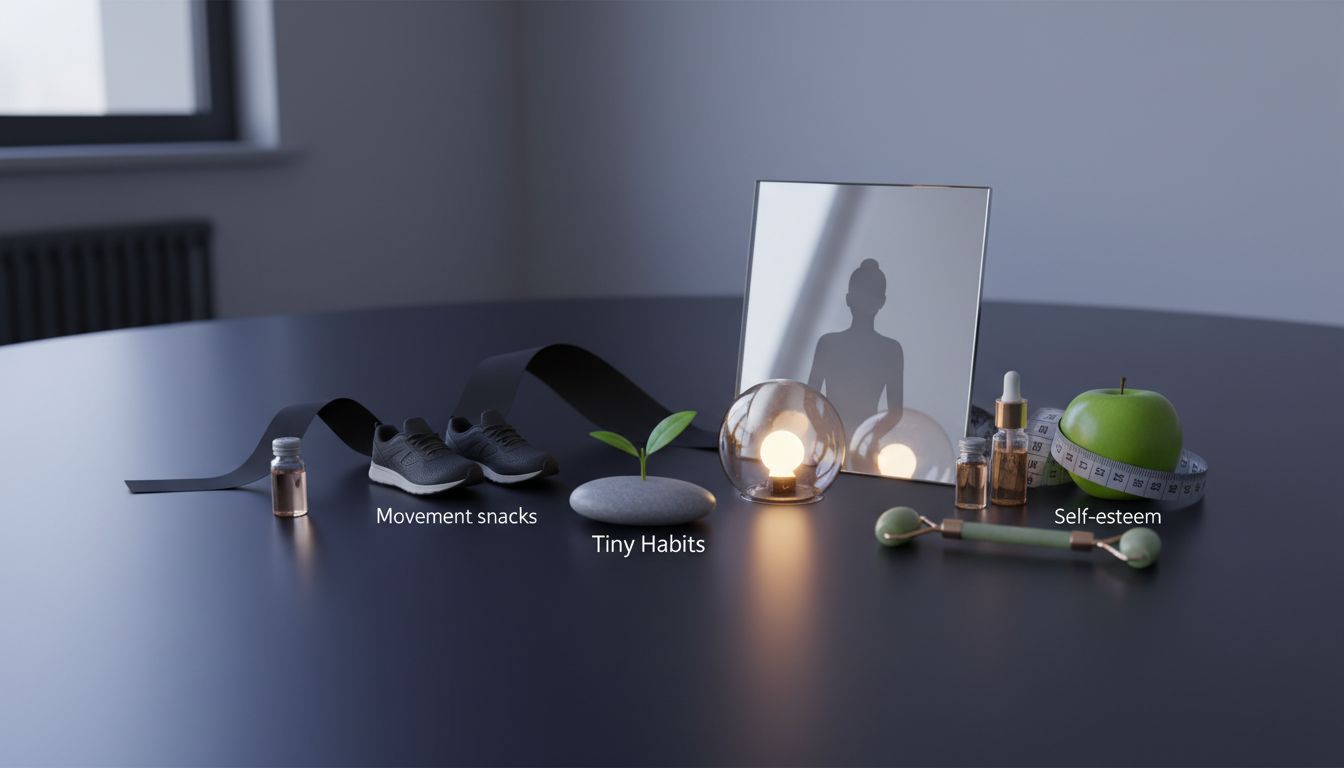

Tiny habits and movement snacks are the kind of easy, low‑friction changes that fit into real life. They are brief bursts of activity or tiny rituals you can do between tasks, at your desk, or while running errands. Because they are small and repeatable they add up,both physiologically and psychologically,and they can quietly boost energy and confidence across days and weeks.
This article will walk through the science behind these tiny moves, practical examples you can try today, and a simple recipe for turning a 30 to 90 second action into a lasting habit. If you have little time but want reliable ways to feel more alert, less stressed, and steadily more confident, these strategies are built for you.
Why tiny moves matter: big population benefits from small changes
Small additions to daily activity have surprisingly large population‑level impacts. For example, a Lancet analysis (Jan 2026) modeled that adding roughly five minutes per day of moderate activity, like a brisk 5 km/h walk, was associated with about 10% fewer deaths across adults and roughly 6% fewer deaths among the least active quintile. Reducing sedentary time by 30 minutes a day was linked to about 7% fewer deaths.
Those figures show that tiny, realistic shifts matter for long‑term health. You don’t need an hour at the gym to move the needle,adding a few minutes of intentional movement repeatedly across the week can create measurable benefits at a population level.
That makes tiny habits a practical public‑health friendly approach. They are accessible, low cost, and compatible with busy schedules,qualities that make long‑term adoption far more likely than large, abrupt lifestyle overhauls.
Very short bursts (VILPA) deliver time‑efficient cardiometabolic gains
Research on Vigorous Intermittent Lifestyle Physical Activity, or VILPA, shows that very short, incidental bursts of higher‑intensity movement can be powerful. Device‑measured studies reported that non‑exercisers getting about 3.5 to 4.5 minutes per day of VILPA had substantially lower risk for some cancers,up to roughly 18 to 32% lower for certain cancer outcomes in one JAMA Oncology report (Jul 2023).
Multiple accelerometer‑based cohort studies and prospective analyses (including data summarized in Nature Medicine and other wearable cohorts) link brief high‑intensity bursts to lower all‑cause mortality and fewer major cardiovascular events. The European Heart Journal summarized that accumulating short vigorous bouts (often 1,2 minutes each, totaling about 15,20 minutes per week) is associated with lower mortality and reduced CVD and cancer incidence compared with no vigorous activity.
In everyday life, VILPA shows up as stair climbs, brisk 60,90 second power walks, or carrying heavy shopping with a quicker pace. Most VILPA bouts detected in cohort data were a minute or less, which confirms how naturally these moments can be embedded into normal routines.
Microbreaks and movement snacks for energy, focus, and mood
Short active breaks,sometimes called microbreaks or movement snacks,have reliable short‑term effects on energy and fatigue. Controlled trials and meta‑analyses report increases in vigor and alertness and reductions in subjective fatigue and stress when people take 1,5 minute active breaks during the workday. Those effects are repeatable when breaks are frequent.
Brief activity can also help preserve cognitive performance. Randomized trials show that inserting 2,5 minute walks or dynamic stretches across the work or school day helps maintain attention and reduce mid‑afternoon declines. In some cases, frequent short breaks outperform a single longer bout for sustaining performance over the afternoon.
Outdoor micro‑walks amplify the effect: brief walks in green space (10,15 minutes) produce larger improvements in attention and brain markers of working memory compared with indoor walks, suggesting that pairing movement with time outside magnifies restoration and focus.
How tiny habits build confidence: small wins and celebration
The psychology of tiny habits explains why tiny physical actions do more than move the . BJ Fogg’s Tiny Habits method emphasizes starting extremely small, pairing a tiny behavior with an existing anchor, and immediately celebrating the action. That celebration strengthens the cue‑behavior link and creates a positive emotional loop.
Complementing this, the Progress Principle (Amabile & Kramer) shows that registering frequent small wins is one of the strongest drivers of momentary motivation, positive affect, and perceived competence. Each time you complete a tiny movement snack you get a bit of proof,momentary mastery,that you can follow through. Over time these micro‑wins build real self‑efficacy and confidence.
In short, tiny habits are a confidence hack as much as a fitness one: they produce psychological momentum by combining achievable action, immediate positive feedback, and repetition.
Practical movement‑snack examples and a simple tiny‑habit recipe
Real‑world movement snacks are easy to imagine and easy to do. Examples include climbing a flight of stairs between meetings, a brisk 60,90 second walk after dropping mail in the box, carrying groceries with a quicker pace, 60 seconds of calf raises or squats at a standing desk, or brisk marching in place while waiting for a kettle to boil. Most VILPA bouts described in research were a minute or less, so these examples map directly to the evidence.
Here is an evidence‑informed tiny habit recipe you can use today: choose a cue, pick a tiny movement, and celebrate. For example: After I stand to get water (cue), I will briskly march on the spot for 30 seconds (tiny movement), then I will celebrate with a fist pump and say yes to myself (celebration). Repeat this frequently across the day. Short, believable goals and immediate positive feedback leverage both habit formation and the physiological benefit of repeated activity.
Some key numbers to remember: most VILPA bouts last one minute or less; roughly 3.5,4.5 minutes per day of VILPA is associated with large cancer‑risk reductions in non‑exercisers; about 15,20 minutes per week of accumulated vigorous bouts relates to lower mortality; and adding roughly 5 minutes per day of moderate activity at a population level was modeled to prevent about 6,10% of deaths (Lancet 2026, JAMA Oncology, European Heart Journal summaries).
Workplace strategies, wearables, and realistic implementation
Workplaces are a great place to normalize movement snacks. Trials of short resistance and mobility snack programs (2,5 minutes repeated across the day) improve musculoskeletal comfort and shoulder/neck function, and these short programs often achieve better adherence than longer once‑daily sessions. For desk workers, that practical simplicity is key.
Wearables and device measurement make personalized micro‑prescriptions practical. Recent analyses from large cohorts show we can quantify incidental movement patterns and model their health impact, enabling realistic prompts and tailored goals. A smartwatch or activity tracker that nudges you to take two 1‑minute VILPA bursts each day is a low‑barrier way to translate the science into habit.
For product picks, look for simple options: an app or watch with customizable activity reminders, a small step counter, or a timer for microbreaks. The best tool is the one you will actually use,start with what’s familiar and inexpensive, and experiment until you find a rhythm that fits your day.
Evidence caveats and realistic expectations
It’s important to be clear about limitations. Much of the VILPA evidence is observational or comes from short‑term trials; associations do not prove causality and effect sizes vary by baseline activity, population, and measurement method. Nevertheless, device‑measured observational work and randomized microbreak trials converge to support frequent, tiny movement as a low‑risk, high‑feasibility strategy for improving energy, mood, and possibly long‑term health.
Think of movement snacks as complementary, not a panacea. They are a practical adjunct to other health behaviors,sleep, nutrition, medical care,and they are especially valuable for people who struggle to fit longer workouts into busy lives. If you have medical conditions or concerns, check with your clinician about intensity and pacing before starting vigorous bursts.
The real promise is simple: tiny habits lower the activation energy for change. They make movement habitual, make wins frequent, and make progress feel doable, which together boost both physical and psychological resilience.
Start with one tiny action today. Pair it with a cue you already do, keep the duration believable, celebrate each completion, and repeat often. Over weeks those minutes add up to more energy, better focus, and a steady rise in confidence,one small victory at a time.