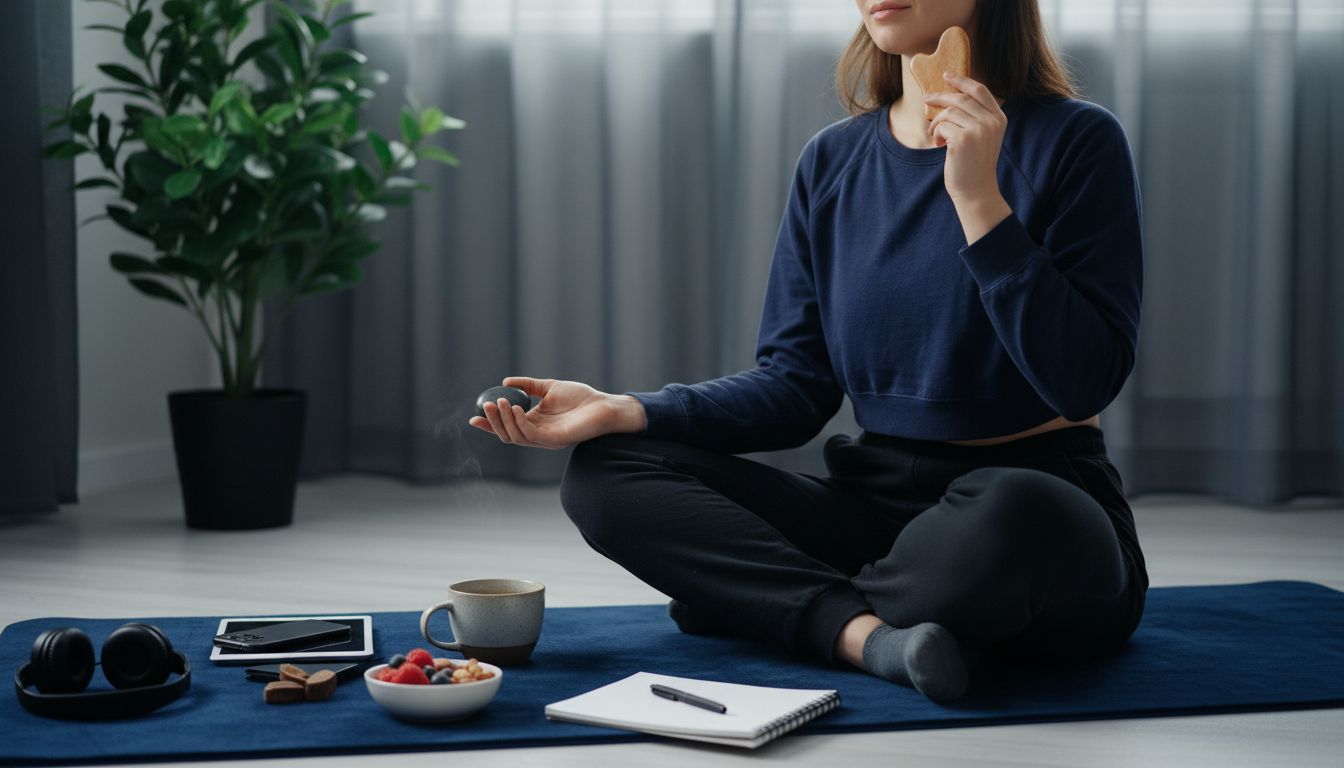

We live in a time when screens are everywhere: work chat, news, social apps and the constant stream of notifications that pull at our attention. Global reports show average daily screen time remains high (around 6.7 hours/day), and the OECD links rising screen exposure with lower subjective well‑being across countries. That makes it urgent to set tech boundaries that protect your sleep, attention and mood.
Creating clear, simple rules for how and when you use devices isn’t about moralizing technology,it’s a practical strategy to reclaim focus and rebuild confidence. Paired with very short, evidence‑based micro‑calm moves, these boundaries help you do better work, feel less stressed and accumulate small wins that boost self‑belief.
Why set tech boundaries now
Screen time and after‑hours digital contact have become public‑health topics: policymakers and employers are responding with “right‑to‑disconnect” initiatives and company rules to limit late messages. The EU and Eurofound reports show a growing movement to formalize these protections, and that institutional momentum makes it easier for individuals to ask for,and keep,boundaries.
Attention science explains what happens when we don’t set limits. S. Leroy’s work on “attention residue” (2009) shows that switching tasks or letting devices interrupt you leaves leftover attention on the prior task and degrades subsequent performance. That’s why frequent pings feel chaotic and make focused work harder.
Beyond productivity, interrupted nights and constant connectivity harm well‑being. OECD analyses link rising screen exposure to lower subjective well‑being, and DataReportal/Digital 2025 underscores that average online hours remain high globally, so intentional boundaries are statistically urgent for attention, sleep and mood.
How to set practical boundaries: a quick, evidence‑backed recipe
Start with 2,3 hard rules you can keep. Examples that work for many people: schedule Do Not Disturb/work Focus from 9,11am, stop checking work messages after 7pm, and keep phone chargers outside the bedroom. These are concrete, testable commitments,not vague intentions.
Use built‑in tools to enforce them: Apple’s Screen Time & Focus modes, Android’s Digital Wellbeing and Focus mode, and app timers let you schedule app limits, silence or allow specific notifications, and create predictable no‑notification blocks. Pair each scheduled boundary with a chosen micro‑calm move so the boundary becomes a ritual, not an annoyance.
When possible, ask your workplace to formalize disconnect rules. The “right to disconnect” movement and employer policies (EU/Eurofound reporting) show that organizational support reduces pressure to answer off hours. Even if formal policy isn’t available, sharing your boundary with colleagues and scheduling clear focus blocks sets expectations and protects your attention.
Micro‑calm move 1: 60‑second box/slow breathing
Box or slow breathing is a fast physiological reset you can do anywhere: inhale for 4 (or 5,6) counts, hold for 4, exhale for 4, hold for 4. Even one minute of controlled breathing increases heart‑rate variability and reduces physiological arousal, according to meta‑analytic evidence.
Use this 60‑second practice before an important call, after an interruption, or when you notice your heart racing. It clears stress and primes working memory for the next task,so you return to focus in a calmer state.
Tip: Pair one scheduled boundary (for example, start of a 25‑minute focus block) with a 60‑second breathing reset. Over time these micro‑resets cue your nervous system to settle more quickly, making deep work easier.
Micro‑calm move 2: 2,3 minute active microbreak
Short active breaks,standing, shoulder rolls, a brisk walk around the room,are supported by systematic reviews showing that 2,3 minute microbreaks every ~30,60 minutes reduce fatigue, musculoskeletal strain and stress without hurting productivity.
These breaks are not procrastination; they’re micro‑maintenance. They reset posture, relieve tension and restore attention so you can return to work with less discomfort and more clarity.
Practical cue: schedule a microbreak timer (every 25,60 minutes) using Digital Wellbeing or a simple timer app. When the alarm rings, stand up, stretch or walk for two minutes,no screens,then get back to your single‑task block.
Micro‑calm move 3: 90‑second focused‑attention practice
Brief guided mindfulness,1 to 3 minutes,has measurable benefits. Randomized trials and RCTs show that short focused‑attention sessions reduce stress and improve attentional markers for novices and workers alike. You don’t need a long meditation practice to gain benefits.
Try a 90‑second breath or ‑scan: notice the inhale, notice the exhale, feel the for three cycles. If your mind wanders, gently bring it back,no judgment. This trains your attention to re‑orient quickly after interruptions.
Make it easy: keep a 90‑second guided clip or app shortcut on your phone or desktop, then pair it with a boundary (for example, the end of a work call or the start of a reading session) so it becomes a repeatable habit.
Micro‑calm move 4: single‑task focus block + notification lockdown
Cal Newport’s deep‑work framework is simple: schedule intentional, uninterrupted blocks of time and remove distractions. That means choosing a time window (25, 50 or 90 minutes), turning off notifications and hiding your inbox to prevent attention residue.
Use Focus modes, app timers, or even a separate work device to enforce lockdown. Removing the possibility of an interruption prevents the cognitive cost of switching and improves the quality of your work, according to attention studies.
Start small,one daily 25‑minute block,and grow from there. Pair each focus block with an explicit start ritual (60‑second breathing) and an end ritual (a 2‑minute microbreak plus a micro‑win note) so the block feels contained and rewarding.
Micro‑calm move 5: micro‑affirmation & micro‑win journaling
Small wins compound. The Progress Principle and decades of self‑efficacy research (Bandura) show that recording short, achievable steps builds perceived competence and sustained motivation. A one‑line daily “win log” is a fast way to capture progress.
Spend 30,60 seconds after each focus block or at the end of the day to write one concrete progress step or a brief affirmation. Simple entries like “Answered three emails and finished slide #1” or “I stayed on task for 25 minutes” reinforce momentum and combat negative rumination.
Albert Bandura reminds us that self‑efficacy is “belief in one’s capabilities to organize and execute the courses of action required to manage prospective situations.” Pair your tech boundaries with this micro‑win habit to rebuild confidence, one small success at a time.
Putting it together: a one‑week plan to reclaim focus
Week starter: pick 2,3 hard boundaries (example: Focus 9,11am, no work messages after 7pm, phone outside bedroom at night). Program those rules into your device (Screen Time/Focus or Digital Wellbeing) so they’re enforced automatically.
Choose a micro‑calm move to pair with each boundary. Example plan: before each focus block do 60 seconds of box breathing; after every 25,50 minutes do a 2‑minute active break; end each block with a 30‑second win log. This pairing makes boundaries feel practical and immediately rewarding.
Remember Cal Newport’s point about rituals: the point is to create predictable blocks of uninterrupted time and a repeatable ritual that signals your brain it’s time to focus. Over a week you’ll notice less reactivity to pings, clearer work sessions and small boosts to your self‑belief.
Set tech boundaries not as punitive rules but as supportive structures that protect attention, sleep and self‑confidence. The evidence,from attention residue to microbreaks, brief mindfulness and slow breathing,shows that small, regular practices move the needle.
Start with one boundary and one micro‑calm move today. Use built‑in tools (Apple Screen Time & Focus, Android Digital Wellbeing), formalize rules where possible, and celebrate the tiny wins. As Bandura and Newport suggest, reclaiming focused, undistracted time rebuilds your capability,and that renewed capability strengthens your belief in yourself.