
Everyday overwhelm does not always look dramatic. More often, it feels like a packed inbox, a racing mind at 3 p.m., tension in your shoulders during a commute, or the sense that your never fully powers down. That is one reason micro-breathwork is getting so much attention in 2026. Instead of asking people to carve out an hour for stress relief, it offers a tiny, repeatable reset you can use in the middle of real life.
The timing makes sense. Gallup’s State of the Global Workplace: 2025 Report found that 40% of employees globally experienced stress “a lot of the previous day,” and the APA’s 2025 Stress in America survey pointed to ongoing background pressure for many U.S. adults, including stress tied to societal division. In that environment, fast calming tools matter. When wearable biofeedback is added to the mix, micro-breathwork becomes even more practical because it gives you a signal, a prompt, and often a simple way to act on stress before it snowballs.
Why micro-breathwork fits modern stress so well
Micro-breathwork simply means very short, intentional breathing practices that can be repeated throughout the day. Think one to five minutes, not a full meditation class. The appeal is obvious for busy adults: it is easy to start, easy to repeat, and much less intimidating than a complicated wellness routine.
This matters because modern stress is often chronic and low-grade rather than one big emergency. You may not feel “in crisis,” but your mind can still stay overstimulated for hours. A short breathing reset between tasks, before a difficult conversation, or right after a stressful notification can interrupt that buildup. It is a practical response to the kind of stress many people actually live with.
Research supports this simple approach. A 2024 systematic review in Applied Nursing Research concluded that self-regulated, controlled breathing exercises are associated with decreased anxiety and increased stress tolerance in adults. That does not mean breathing solves every problem, but it does suggest that brief, regular practice can be a useful tool in a realistic self-care routine.
What controlled breathing is doing in the
One reason breathwork has moved into the mainstream is that researchers are increasingly studying measurable physiology, not only subjective feelings. A 2025 review in OBM Integrative and Complementary Medicine highlighted the growing focus on slow deep breathing, heart rate variability, parasympathetic activation, and vagal mechanisms in stress research. In plain language, your breathing pattern can influence how activated or settled your nervous system feels.
Slow breathing, especially with a slightly longer exhale, is often used because it encourages the to shift away from a constant fight-or-flight style response. Recent research also suggests that slow breathing can reduce psychological stress, and over longer periods may improve anxiety-related scores. For many people, that makes one simple pattern a good place to start: breathe in gently, then exhale a little longer than you inhaled.
The key point is that micro-breathwork is not about breathing “perfectly.” It is about giving your system a better rhythm for a moment. Even a short pause can reduce the feeling of spiraling when your day starts speeding up. Over time, these tiny reps may also help you notice stress sooner and recover faster.
How wearable biofeedback makes calm more tangible
For many people, stress feels vague until it becomes overwhelming. Wearable biofeedback helps by making stress signals more visible. Instead of guessing whether you are wound up, your watch or ring may flag patterns linked to strain, such as changes in heart rate, heart rate variability, movement, or sustained load. That kind of feedback can turn “I feel off” into “I should reset now.”
HRV, or heart rate variability, is one of the most common anchors in this space because it reflects aspects of autonomic balance and can now be monitored with growing sophistication through consumer wearables. Recent literature on HRV biofeedback and remote wearable monitoring shows why this is useful: it gives users a measurable signal they can respond to in the moment, rather than waiting until stress becomes impossible to ignore.
That is also why wearables are shifting from passive trackers to active stress-support tools. Oura says its stress features help users understand “when and how they experience stress and recovery in their daily lives.” Apple describes its Mindfulness app as a way to “set aside a few minutes a day to focus, center, and connect as you breathe.” Both examples show the same broader trend: devices are no longer just counting steps, they are increasingly helping people regulate themselves in real time.
Why haptics and on-wrist guidance lower the barrier
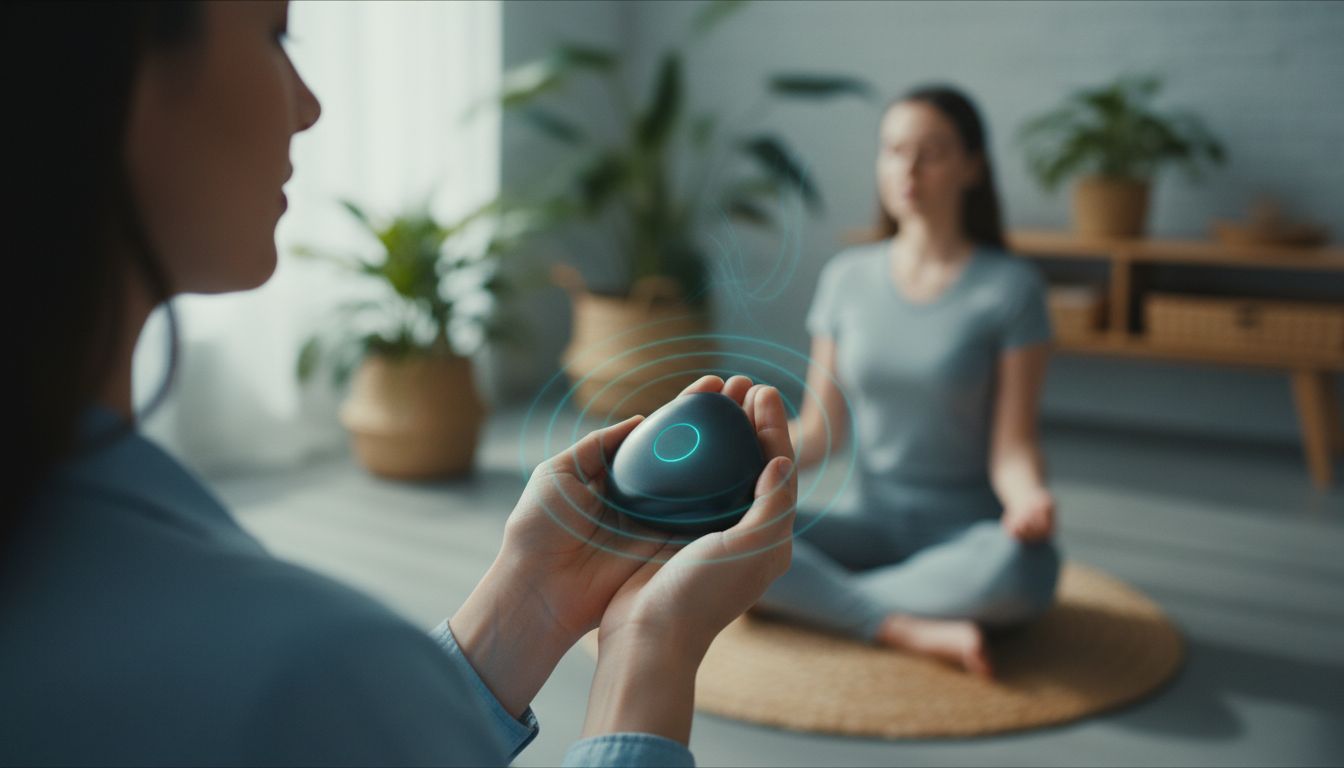
When you are overwhelmed, even helpful advice can feel like too much. That is where haptic guidance becomes surprisingly valuable. A gentle tap on the wrist can prompt you to slow down without forcing you to unlock your phone, read instructions, or stare at a screen. In real life, that convenience matters.
Apple Watch breathing tools are a good example of this trend. The Mindfulness app allows users to practice short guided sessions directly on the wrist and adjust the breathing rate during Breathe sessions. This kind of design is practical because it supports short, discreet calming moments at a desk, on public transport, or while waiting in line. You do not need a special setting to use it.
Haptic guidance is also helpful when visual overload is part of the problem. If your nervous system already feels saturated, another screen can be the opposite of calming. A simple vibration cue can make breathwork more accessible, more private, and easier to stick with during actual stressful moments rather than ideal ones.
What the latest research says about short, repeatable practice
One of the most encouraging parts of the current research is that you may not need long sessions to see meaningful changes. A 2022 PubMed-indexed study combining wearable devices with HRV biofeedback found that four sessions were needed to increase HRV indices and decrease breathing rates. That is a useful reminder that “tiny but repeated” can be effective.
There is also growing evidence that these tools work outside clinics. A 2024 JMIR Mental Health feasibility study found that remote short sessions of HRV biofeedback monitored with wearable technology could be delivered in real-world settings. That supports the idea that calming tools do not have to stay inside therapy offices or specialist programs. They can fit into ordinary days.
Workplace evidence is strengthening too. A 2025 Frontiers in Psychiatry systematic review on biofeedback for work-related stress pointed to a maturing evidence base around self-regulation, wellbeing, and HRV biofeedback in occupational settings. A 2025 Scientific Reports paper also emphasized that workplace biofeedback interventions, including breathing techniques and mobile apps, can significantly reduce stress. For adults juggling deadlines, caregiving, and digital overload, that is highly relevant.
How to use micro-breathwork without overcomplicating it
The simplest approach is to tie micro-breathwork to moments you already have. Try one minute before opening your email, two minutes after a tense meeting, or three slow rounds of breathing when you notice jaw tension. Habit stacking works well here because the goal is not to create another demanding routine. It is to make calming easier to access.
A beginner-friendly pattern is inhale for four seconds and exhale for six seconds, repeated for one to three minutes. If counting feels stressful, let a wearable guide you. Many devices and apps now offer pacing cues so you can follow the rhythm rather than manage the timing yourself. The longer exhale may be especially useful when your feels keyed up.
It also helps to aim for “better,” not “blissful.” The purpose of micro-breathwork is not to become instantly serene. It is to take the edge off, lower the speed of your stress response, and create enough space to make a more grounded next choice. That next choice might be drinking water, standing up, stepping outside, or simply answering one task at a time.
What to look for in a wearable stress-support tool
If you are considering a wearable for stress support, focus on low-friction features first. The best tool is usually the one you will actually use when life gets messy. Helpful features include short guided breathing sessions, clear stress or recovery trends, gentle haptic prompts, and easy-to-read summaries that do not bury you in data.
It is also worth looking for tools that connect stress detection with action. Oura, for example, pairs stress insights with recovery-oriented content such as guided breathwork, meditations, and muscle relaxation. That pairing matters. A stress alert without a simple next step can feel annoying, while a stress alert followed by a one-minute reset can feel supportive.
At the same time, more alerts are not always better. A 2025 study combining wearable-triggered stressors and AI chatbot support found that although many detected events were meaningful, only about one in five truly warranted an intervention. This is a useful reminder to choose tools that respect your attention. Good biofeedback should reduce overwhelm, not create a new layer of it.
The future: just-in-time calming instead of one-size-fits-all wellness
One of the most exciting shifts is the move toward just-in-time adaptive interventions, sometimes called JITAIs. These systems use context, timing, and signals to prompt small actions when they are most likely to help. A 2025 smartwatch JITAI study found that wrist-based prompts led participants to take practical self-regulation actions such as changing location or using earphones to reduce noise. That is a strong sign that tiny interventions can change behavior in daily life.
Wearable stress support is also becoming more personalized. A 2025 study on Garmin-based stress measurement suggested that around a third of participants would engage with the smartwatch app almost every day when burden stayed low. This is important because consistency usually matters more than intensity in behavior change. People are more likely to use tools that feel easy and timely.
Looking a, closed-loop haptic biofeedback is emerging as a promising frontier. Early 2025 research explored adaptive smartwatch vibration patterns designed to influence heart rate and subjective relaxation in real time. In other words, wearables may increasingly move beyond static breathing timers and toward responses that adjust to your as you use them. That could make micro-breathwork even more intuitive and effective for everyday overwhelm.
The big takeaway is that micro-breathwork and wearable biofeedback work well together because they solve two everyday problems at once: noticing stress early and having a realistic way to respond. You do not need a perfect morning routine, a silent meditation room, or endless free time. You need a calm tool that fits into the life you already have.
If you are curious, start small. Try one wearable-guided breathing session a day for a week, or use a simple inhale-exhale pattern during one predictable stress point in your routine. Tiny reps are the point. When practiced consistently, micro-breathwork can become less of a wellness extra and more of an everyday skill for protecting your energy, focus, and self-esteem.